
Menu
Menu
AI solutions
AI-driven Content Creation Dashboard
AI-driven Content Creation Dashboard
AI-driven Content Creation Dashboard
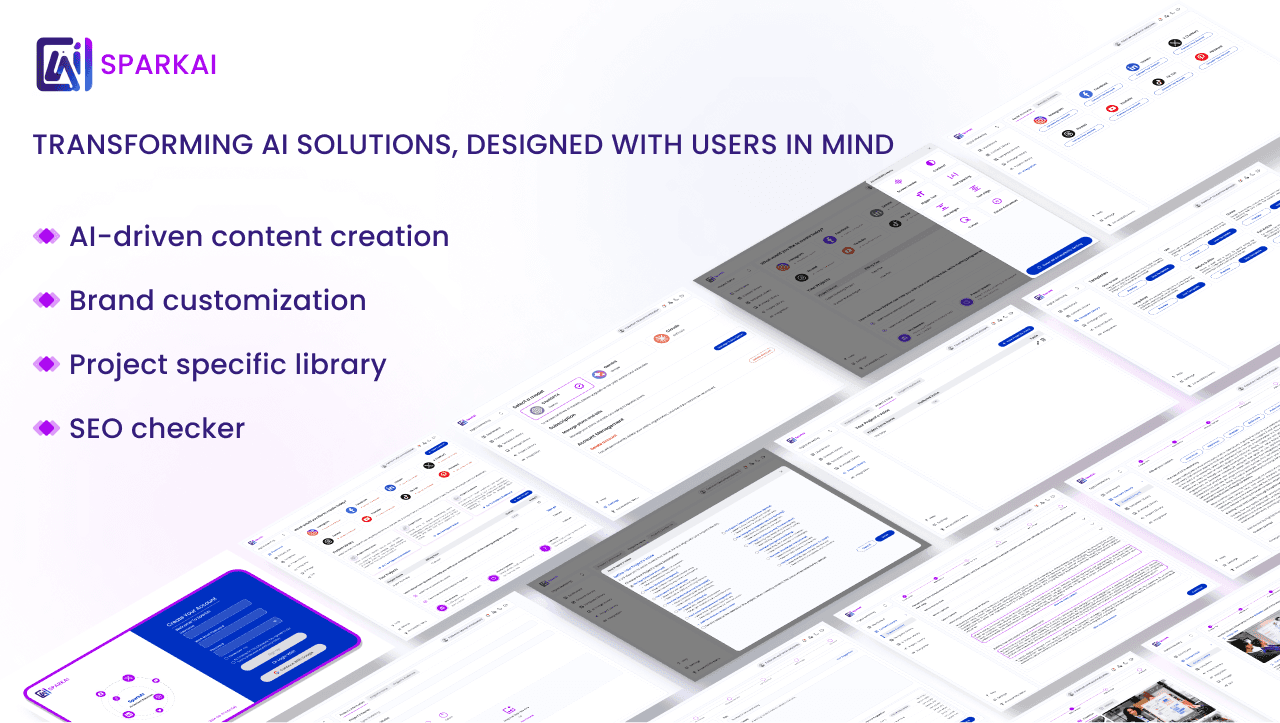
SparkAI is designed to help digital marketers streamline content creation, saving time on repetitive tasks and boosting efficiency with AI-driven solutions.
SparkAI is designed to help digital marketers streamline content creation, saving time on repetitive tasks and boosting efficiency with AI-driven solutions.

Industry
Industry
Digital Marketing & AI Solutions
Digital Marketing & AI Solutions
Role
Role
UX/UI Designer
UX/UI Designer
Project Timeline
Project Timeline
2024
2024
Tools
Tools
Figma, Miro,Photoshop, Balsamiq, Trello
Figma, Miro,Photoshop, Balsamiq, Trello
Challenge
Challenge
In today’s fast-paced digital marketing landscape, content creation can be time-consuming and resource-heavy. Marketers often struggle with balancing creativity and efficiency while catering to different platforms, audience segments, and SEO requirements. Additionally, managing brand tone and voice consistency across multiple projects adds complexity. The challenge is to streamline this process while maintaining high-quality content tailored to different platforms.
In today’s fast-paced digital marketing landscape, content creation can be time-consuming and resource-heavy. Marketers often struggle with balancing creativity and efficiency while catering to different platforms, audience segments, and SEO requirements. Additionally, managing brand tone and voice consistency across multiple projects adds complexity. The challenge is to streamline this process while maintaining high-quality content tailored to different platforms.
Solution
Solution
To tackle these challenges, I created an AI-driven content creation platform tailored for digital marketers. This platform automates social media content generation while ensuring brand voice, tone, and SEO optimization.
To tackle these challenges, I created an AI-driven content creation platform tailored for digital marketers. This platform automates social media content generation while ensuring brand voice, tone, and SEO optimization.
50%
50%
Increase in Content Output
Increase in Content Output
25%
25%
Reduction in Manual Edits
Reduction in Manual Edits
84%
84%
Increase in Content Creation Efficiency
Increase in Content Creation Efficiency
check out the final prototypes In Figma
check out the final prototypes In Figma
check out the final prototypes In Figma

Desk Research
Desk Research
Desk Research
What Are Digital Marketers and Companies Saying About Content Creation?
What Are Digital Marketers and Companies Saying About Content Creation?
What Are Digital Marketers and Companies Saying About Content Creation?
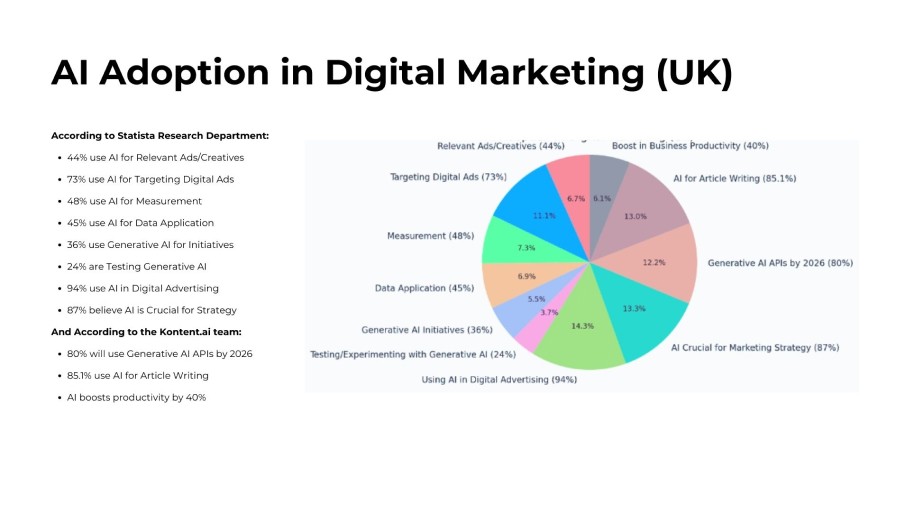
To understand the key challenges faced by digital marketers and companies, I reviewed industry reports and user feedback. Here are the key insights:
To understand the key challenges faced by digital marketers and companies, I reviewed industry reports and user feedback. Here are the key insights:
To understand the key challenges faced by digital marketers and companies, I reviewed industry reports and user feedback. Here are the key insights:

User Interviews
User Interviews
User Interviews
To better understand the challenges and needs of digital marketers, I conducted semi-structured interviews with nine digital marketers from various experience levels, including junior, midlevel, senior, and expert professionals. This group consisted of two expert interviews and seven interviews with other professionals, providing a diverse range of perspectives.
The goal was to gather insights into their daily workflows, current pain points, and their perceptions of AI tools in content creation.
Interview Questions
Interview Questions
Interview Questions
Get to Know the Candidate
Get to Know the Candidate
Get to Know the Candidate
What is your current role in digital marketing?
How many years of experience do you have in this field?
Describe your typical day as a digital marketer.
What is your current role in digital marketing?
How many years of experience do you have in this field?
Describe your typical day as a digital marketer.
What is your current role in digital marketing?
How many years of experience do you have in this field?
Describe your typical day as a digital marketer.
Aim: Understanding background, roles, and current challenges.
Aim: Understanding background, roles, and current challenges.
Aim: Understanding background, roles, and current challenges.
Understand the Use of Content Creation Tools
Understand the Use of Content Creation Tools
Understand the Use of Content Creation Tools
What tasks do you perform most frequently in your role?
What are your go-to tools/software for content creation?
Do you use any AI tools for content creation? If so, which ones?
How satisfied are you with the performance of these tools?
What tasks do you perform most frequently in your role?
What are your go-to tools/software for content creation?
Do you use any AI tools for content creation? If so, which ones?
How satisfied are you with the performance of these tools?
What tasks do you perform most frequently in your role?
What are your go-to tools/software for content creation?
Do you use any AI tools for content creation? If so, which ones?
How satisfied are you with the performance of these tools?
Aim: Identifying tools used and exploring their effectiveness.
Aim: Identifying tools used and exploring their effectiveness.
Aim: Identifying tools used and exploring their effectiveness.
Challenges and Expectations for AI in Content Creation
Challenges and Expectations for AI in Content Creation
Challenges and Expectations for AI in Content Creation
What do you find most difficult in the content creation process?
How do you think AI can help improve content creation?
What improvements would you like to see in current AI content creation tools?
Do you have any ethical concerns when using AI for content creation? If so, how do you address them?
What do you find most difficult in the content creation process?
How do you think AI can help improve content creation?
What improvements would you like to see in current AI content creation tools?
Do you have any ethical concerns when using AI for content creation? If so, how do you address them?
What do you find most difficult in the content creation process?
How do you think AI can help improve content creation?
What improvements would you like to see in current AI content creation tools?
Do you have any ethical concerns when using AI for content creation? If so, how do you address them?
Aim: Gaining insights into the perceived value, limitations, and desired improvements for AI tools.
Aim: Gaining insights into the perceived value, limitations, and desired improvements for AI tools.
Aim: Gaining insights into the perceived value, limitations, and desired improvements for AI tools.
Summarizing Insights
Summarizing Insights
Summarizing Insights
After gathering insights from interviews and desk research, I organized users' needs and digital marketers' expectations for AI content creation tools. Using affinity diagramming, I grouped the findings into main themes to better understand the challenges and requirements for the SparkAI app.
After gathering insights from interviews and desk research, I organized users' needs and digital marketers' expectations for AI content creation tools. Using affinity diagramming, I grouped the findings into main themes to better understand the challenges and requirements for the SparkAI app.
After gathering insights from interviews and desk research, I organized users' needs and digital marketers' expectations for AI content creation tools. Using affinity diagramming, I grouped the findings into main themes to better understand the challenges and requirements for the SparkAI app.
Connect to Content
Add layers or components to infinitely loop on your page.
Connect to Content
Add layers or components to infinitely loop on your page.

UX Designer
fmohammadzadeh028@gmail.com
Let’s connect!
Connect to Content
Add layers or components to infinitely loop on your page.
Connect to Content
Add layers or components to infinitely loop on your page.
UX Designer
fmohammadzadeh028@gmail.com
Let’s connect!
© 2024. Designed by Fatemeh Mohammadzadeh

Key Needs of Digital Marketers
Key Needs of Digital Marketers
Key Needs of Digital Marketers

User Archetypes & Empathy Maps
User Archetypes & Empathy Maps
User Archetypes & Empathy Maps
Combining our key insights led us to identify two main user personas, each representing a unique set of needs and expectations for interacting with AI tools.
Combining our key insights led us to identify two main user personas, each representing a unique set of needs and expectations for interacting with AI tools.
Combining our key insights led us to identify two main user personas, each representing a unique set of needs and expectations for interacting with AI tools.
Emily - Junior to Mid-Level Marketer: Emily values simplicity and guidance in her tools to support daily tasks and help her grow confident in using AI for content creation.
Emily - Junior to Mid-Level Marketer: Emily values simplicity and guidance in her tools to support daily tasks and help her grow confident in using AI for content creation.
Emily - Junior to Mid-Level Marketer: Emily values simplicity and guidance in her tools to support daily tasks and help her grow confident in using AI for content creation.
Michael - Senior to Expert Marketer: Michael seeks advanced features and customization options, allowing him to refine content strategies and gain deeper control over AI-driven outputs.
Michael - Senior to Expert Marketer: Michael seeks advanced features and customization options, allowing him to refine content strategies and gain deeper control over AI-driven outputs.
Michael - Senior to Expert Marketer: Michael seeks advanced features and customization options, allowing him to refine content strategies and gain deeper control over AI-driven outputs.
This level-based approach provided insights into how digital marketers at different stages engage with AI tools, ensuring that we develop features suited to their needs.
This level-based approach provided insights into how digital marketers at different stages engage with AI tools, ensuring that we develop features suited to their needs.
This level-based approach provided insights into how digital marketers at different stages engage with AI tools, ensuring that we develop features suited to their needs.

With our personas in mind, I mapped out customer journeys to explore each step of the user experience—from initial discovery of the tool to final outcomes.
Finally, I crafted user stories to detail specific ways users would engage with the product, focusing on what they want to achieve and why. Alongside these, I developed point-of-view statements to encapsulate users' perspectives, distilling their needs and challenges into clear, actionable insights.

Competitors
Competitors
Competitors
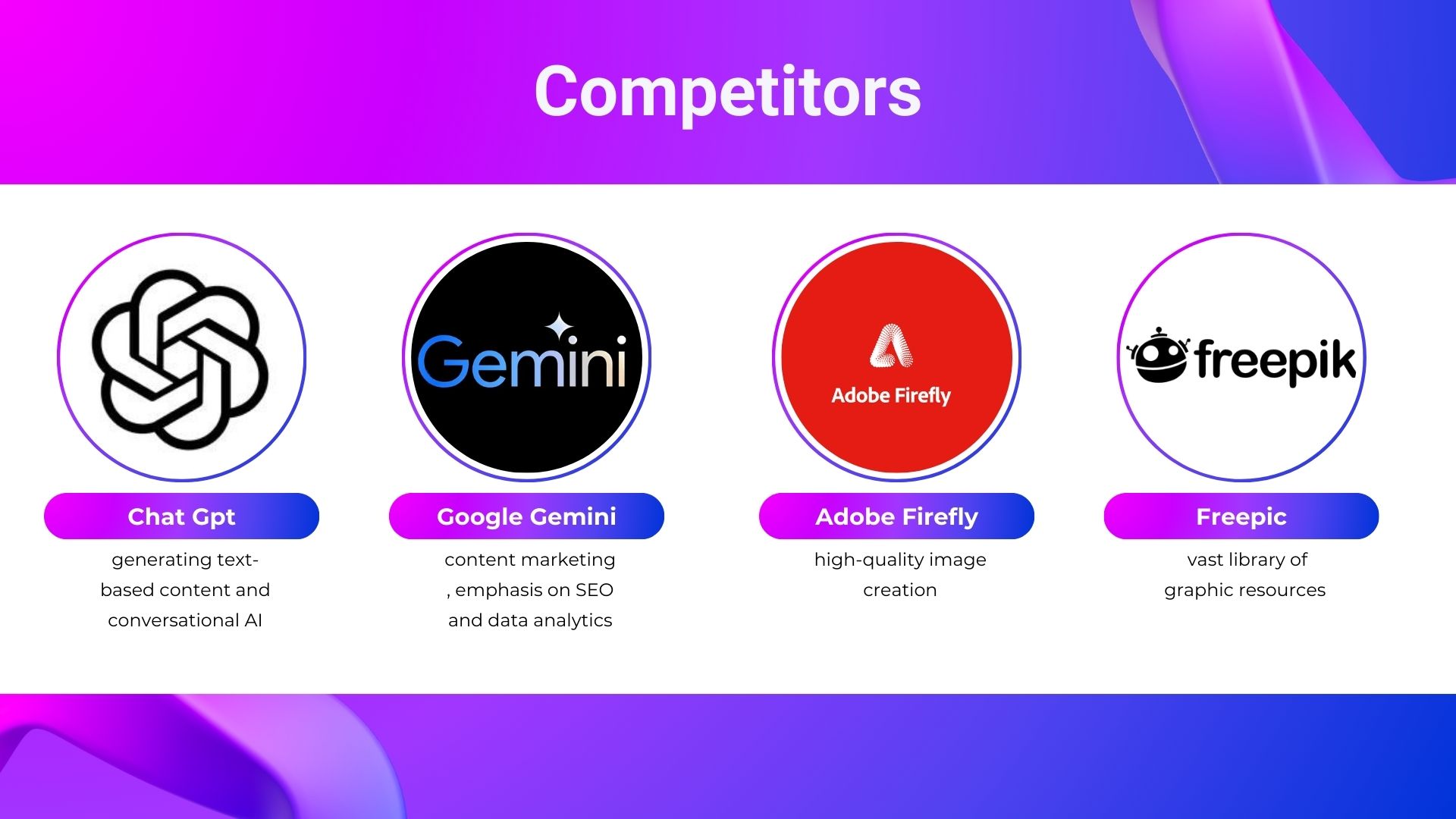
Competitor analysis was conducted to gain insights into the strengths, weaknesses, and gaps in existing solutions within the market.
Competitor analysis was conducted to gain insights into the strengths, weaknesses, and gaps in existing solutions within the market.
Competitor analysis was conducted to gain insights into the strengths, weaknesses, and gaps in existing solutions within the market.

Ideation
Ideation
Ideation
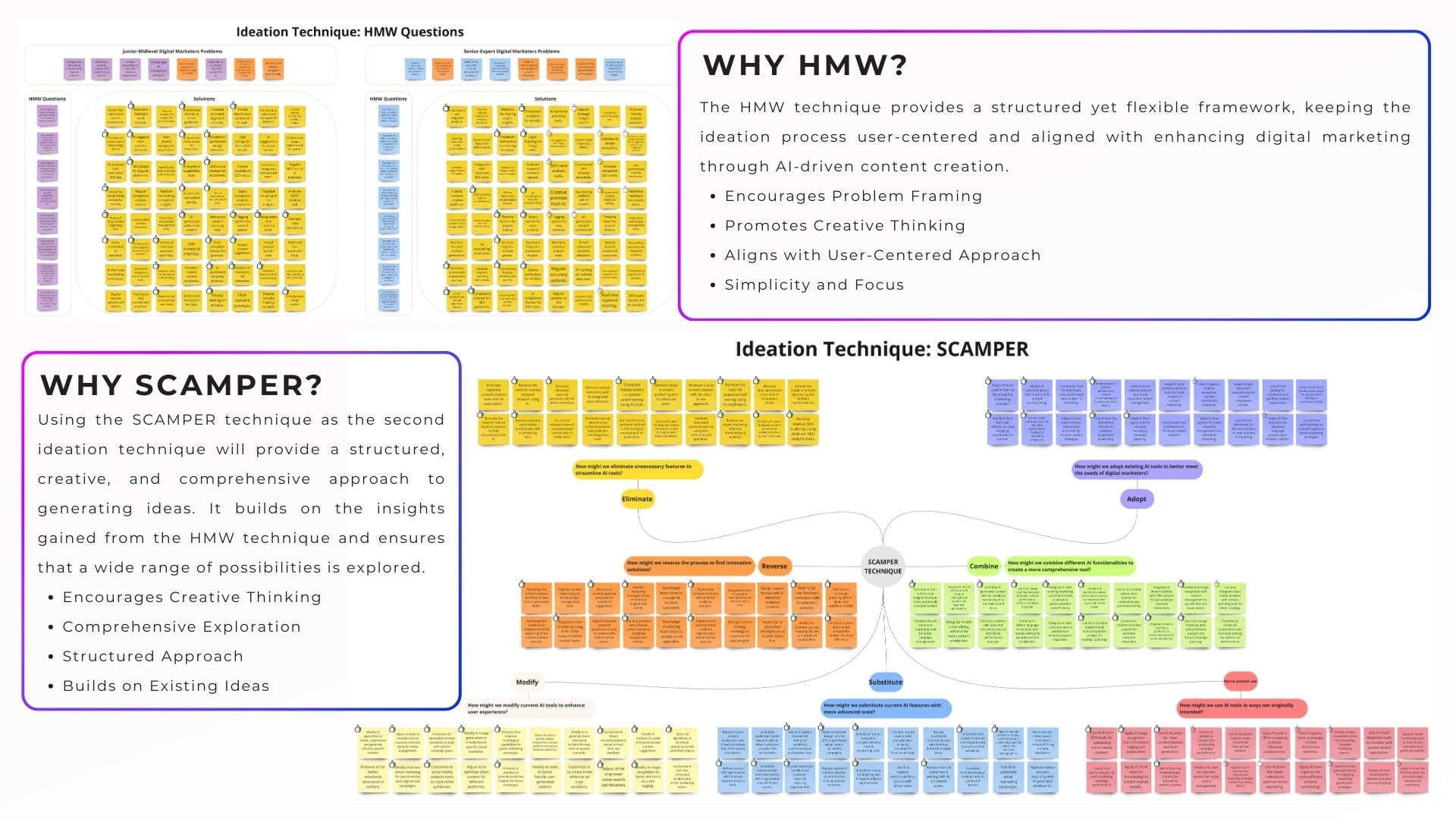
After identifying the key user challenges, understanding persona archetypes, and reviewing how competitors are addressing similar needs, I chose HMW (How Might We) and SCAMPER as ideation techniques. The HMW technique helped frame the problem from the users' perspective, while SCAMPER provided a structured, versatile approach to generating innovative solutions that align with both business goals and user needs.
After identifying the key user challenges, understanding persona archetypes, and reviewing how competitors are addressing similar needs, I chose HMW (How Might We) and SCAMPER as ideation techniques. The HMW technique helped frame the problem from the users' perspective, while SCAMPER provided a structured, versatile approach to generating innovative solutions that align with both business goals and user needs.
After identifying the key user challenges, understanding persona archetypes, and reviewing how competitors are addressing similar needs, I chose HMW (How Might We) and SCAMPER as ideation techniques. The HMW technique helped frame the problem from the users' perspective, while SCAMPER provided a structured, versatile approach to generating innovative solutions that align with both business goals and user needs.
To prioritize the best ideas, I used the NUF Test Table to evaluate each solution based on its feasibility and impact on both the user experience and business objectives.
To prioritize the best ideas, I used the NUF Test Table to evaluate each solution based on its feasibility and impact on both the user experience and business objectives.
To prioritize the best ideas, I used the NUF Test Table to evaluate each solution based on its feasibility and impact on both the user experience and business objectives.

Prototypes
Prototypes


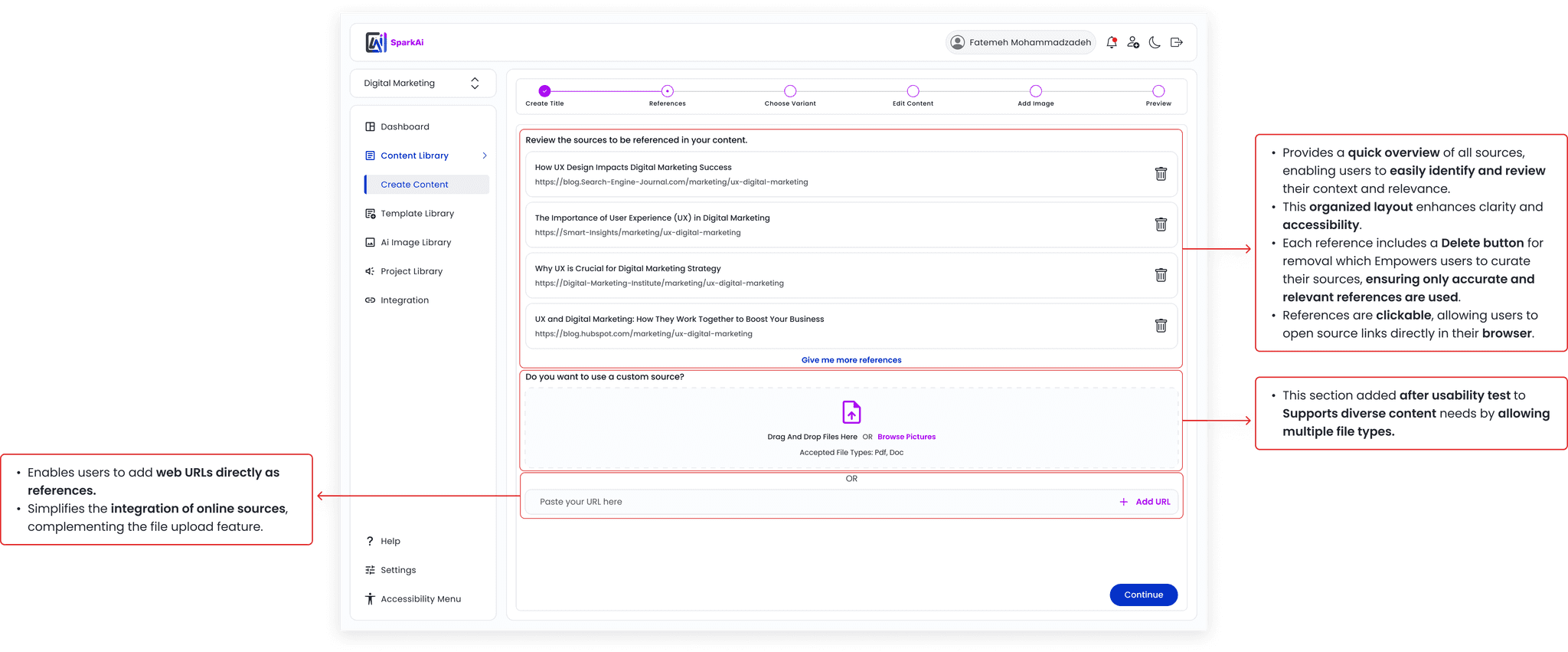
To create a cohesive user journey, I connected all the pages into a complete wireflow in Balsamiq, showing how the app’s different sections interact. I then tested these mid-fidelity prototypes with two digital marketers to observe the design’s effectiveness. Based on their feedback, I refined the prototypes further into high-fidelity designs, incorporating more detailed visuals and interactions to better meet user needs and business goals.
To create a cohesive user journey, I connected all the pages into a complete wireflow in Balsamiq, showing how the app’s different sections interact. I then tested these mid-fidelity prototypes with two digital marketers to observe the design’s effectiveness. Based on their feedback, I refined the prototypes further into high-fidelity designs, incorporating more detailed visuals and interactions to better meet user needs and business goals.
To create a cohesive user journey, I connected all the pages into a complete wireflow in Balsamiq, showing how the app’s different sections interact. I then tested these mid-fidelity prototypes with two digital marketers to observe the design’s effectiveness. Based on their feedback, I refined the prototypes further into high-fidelity designs, incorporating more detailed visuals and interactions to better meet user needs and business goals.


The brand mission and mood board outline the visual and emotional direction for the app's design.
The brand mission and mood board outline the visual and emotional direction for the app's design.
The brand mission and mood board outline the visual and emotional direction for the app's design.

High-Fidelity UI Screens
High-Fidelity UI Screens
High-Fidelity UI Screens




Connect to Content
Add layers or components to infinitely loop on your page.
Connect to Content
Add layers or components to infinitely loop on your page.
Connect to Content
Add layers or components to infinitely loop on your page.
fmohammadzadeh028@gmail.com - User Experience Designer
Let’s connect !
© 2024. Designed by Fatemeh Mohammadzadeh
Connect to Content
Add layers or components to infinitely loop on your page.
Connect to Content
Add layers or components to infinitely loop on your page.
Connect to Content
Add layers or components to infinitely loop on your page.
fmohammadzadeh028@gmail.com - User Experience Designer
Let’s connect !
© 2024. Designed by Fatemeh Mohammadzadeh
Key Needs of Digital Marketers
User Archetypes & Empathy Maps
Combining our key insights led us to identify two main user personas, each representing a unique set of needs and expectations for interacting with AI tools.
Emily - Junior to Mid-Level Marketer: Emily values simplicity and guidance in her tools to support daily tasks and help her grow confident in using AI for content creation.
Michael - Senior to Expert Marketer: Michael seeks advanced features and customization options, allowing him to refine content strategies and gain deeper control over AI-driven outputs.
This level-based approach provided insights into how digital marketers at different stages engage with AI tools, ensuring that we develop features suited to their needs.
With our personas in mind, I mapped out customer journeys to explore each step of the user experience—from initial discovery of the tool to final outcomes.
Finally, I crafted user stories to detail specific ways users would engage with the product, focusing on what they want to achieve and why. Alongside these, I developed point-of-view statements to encapsulate users' perspectives, distilling their needs and challenges into clear, actionable insights.
Competitors
Competitor analysis was conducted to gain insights into the strengths, weaknesses, and gaps in existing solutions within the market.
Ideation
After identifying the key user challenges, understanding persona archetypes, and reviewing how competitors are addressing similar needs, I chose HMW (How Might We) and SCAMPER as ideation techniques. The HMW technique helped frame the problem from the users' perspective, while SCAMPER provided a structured, versatile approach to generating innovative solutions that align with both business goals and user needs.
To prioritize the best ideas, I used the NUF Test Table to evaluate each solution based on its feasibility and impact on both the user experience and business objectives.
Prototypes
To create a cohesive user journey, I connected all the pages into a complete wireflow in Balsamiq, showing how the app’s different sections interact. I then tested these mid-fidelity prototypes with two digital marketers to observe the design’s effectiveness. Based on their feedback, I refined the prototypes further into high-fidelity designs, incorporating more detailed visuals and interactions to better meet user needs and business goals.
The brand mission and mood board outline the visual and emotional direction for the app's design.
High-Fidelity UI Screens